Chestnuts & Sweet Chestnuts: Differences, Origin, Season and Buying Guide

Chestnuts are one of those ingredients that don’t just signal the arrival of a season—they make it tangible through food. As soon as their dark shells gently split in the heat, releasing a warm, lightly toasted sweetness, autumn makes its way into the
kitchen.

But not all chestnuts are the same. There are subtle differences in origin, flavour and texture between everyday sweet chestnuts and premium marrons. Once you understand how these qualities work together, you can shop more selectively and bring their velvety, nutty sweetness to life on your plate.

Chestnuts vs. Marrons: The Difference at a Glance

Closely related, yet distinctly different: marrons and sweet chestnuts both come from the sweet chestnut tree (Castaneasativa). Yet the name “marron” brings together the finest qualities—uniform, plump nuts, a far more intense flavor, and a shell that yields almost effortlessly.

Sweet chestnut
Chestnut
Sweet chestnut
Chestnut
Edible

Ja

Ja

Botanical origin

Castanea sativa

Castanea sativa

Taste

Mild, nutty, slightly sweet

Pronounced sweetness, more intense aromas

Form

Often slightly smaller and more irregular

Usually larger, more uniform, plump

Fruit covering

Densely covered with fine spines

Densely covered with fine spines 

Leaves

Land, narrow and serrated

Long, narrow and serrated

In cooking, the sweet chestnut reveals its true character through texture: heat transforms its firm flesh into a velvety, delicately creamy consistency, while its natural sweetness becomes deep and pronounced. 

In the kitchen, each variety has a clear role: 

  • Common sweet chestnuts reliably add depth to traditional comfort food, hearty stews or stuffings
  • Premium marrons shine wherever the pure chestnut takes centre stage, gently glazed, oven-roasted or served as a side that brings elegance to your plate

Identifying Sweet Chestnuts: Leaves, Husks and Grading

The smooth shell tempts you to grab one straight away—but quality for cooking starts with the tree. If you’re looking for the makings of exceptional roasted flavor in autumn, look closely at the subtle differences in branches and fruit. Sweet chestnut leaves are long and narrow, with distinctly serrated edges and a firm, leathery feel. Later in the year, their husks form a dense covering of fine, needle-sharp spines. This protective layer encloses the starchy flesh, which develops a rich, creamy, velvety sweetness when cooked. 

The inedible horse chestnut is fundamentally different: its leaves form a hand-shaped outline. Its outer husk is more sparsely covered, with only a few scattered, blunt spikes.

The selection for the harvest:

  • Fine, dense spines and elongated individual leaves: The hallmarks of the edible sweet chestnut – the foundation for glazed chestnut side dishes, silky veloutés and rich chestnut flavor 
  • Hand-shaped leaves and scattered spines: These belong to the horse chestnut. It is inedible and serves only nature

Chestnut Season: The Window for the Perfect Melt

Nature kicks off the fresh chestnut season between late September and November. During these weeks, chestnuts reach their ideal biochemical balance of moisture, concentrated starch and natural nutty sweetness.

In the kitchen, this is the window for enjoying their texture at its best: under controlled heat, the natural sugars caramelize on the surface while the center softens to a velvety, almost creamy, melt-in-the-mouth consistency. A peak of flavor that only reveals its full depth during the fresh chestnut season.

Season and Product Form: The Culinary Calendar

Texture & Flavor Profile
Kitchen Tips & Recommendations
Texture & Flavor Profile
Kitchen Tips & Recommendations
End of September

Crisp, naturally juicy, subtly sweet

First Fresh Harvest: High-Heat Searing,
Delicate Vegetable Additions

October to November

Fully ripe, maximum starch concentration, creamy melt-in-your-mouth texture

Peak season: Whole fruits, glazed,
starchy fillings & rich Velvet
soups

December to January

Concentrated sweetness, gentle
residual moisture

Winter holiday menus, rich
reductions & desserts

Year-round (vacuum / sous vide)

Consistent binding, even
texture

A base for velvety purées,
thickening sauces & efficient mise
en place

To enjoy the product at its purest, with its full range of textures, choose fresh produce in peak season. For consistent thickening in purées or sauces, however, an expertly prepared, vacuum-packed product delivers precision you can rely on.

Buying Chestnuts: The Wrist Quality Check

You can judge a chestnut's quality in the kitchen long before it meets the heat. An excellent chestnut reveals itself in its ratio of volume to weight: a flawless one feels surprisingly heavy in your hand. Its firm shell fits snugly around the juicy flesh, with no air gap. 

If the flesh has lost moisture from being stored too long, the kernel shrinks. The telltale rattle when you shake it reveals this moisture loss—the texture becomes dry and loses its melt-in-the-mouth quality.

The freshness check for your shopping:

  • Weight & Density: A heavy feel indicates juicy flesh
  • Firmness: The skin should feel firm and taut when pressed
  • Intact Shell: No tiny boreholes (a sign of pests) and no rattling inside

Fresh or Sous Vide: The Right Format for Preparation

Choosing between fresh and pre-cooked chestnuts isn't a question of quality, but of the role they play in your dish. Scoring, roasting and peeling fresh chestnuts while hot is essential when you want them to take centre stage – whether roasted until crisp in the oven, glazed in nutty brown butter or served as an eye-catching feature on the plate. 

High-quality vacuum-packed chestnuts, on the other hand, offer reliable consistency for sauce-making. Their dense starch structure binds emulsions instantly and gives purées a silky texture with no prep time. 

Uses at a glance:

  • Fresh chestnuts: Glazed chestnut side dishes, crisp roasted elements, stand-alone garnishes. 
  • Pre-cooked chestnuts: Veloutés, melt-in-the-mouth purées, poultry stuffings, desserts & parfaits

Flavor profile: The interplay of strength, sweetness, and smoke

Unlike high-fat tree nuts, chestnuts are packed with starch. Raw, their flesh is firm and their flavor remains locked away. Only heat breaks down the starch chains and triggers the characteristic formation of sugars. 

A complex range of flavors unfolds on your palate: 

  • Natural, nutty sweetness from caramelized simple sugars. 
  • A velvety, floury texture that melts in your mouth, thanks to swollen starch granules. 
  • Warm, roasted aromas that pair perfectly with rich sauces. 
  • Earthy notes that lend the dish a comforting depth.

Chestnuts in the Kitchen: Flavor Pairings for Your Plate

With its subtle sweetness, the chestnut brings flavors together beautifully. It softens sharp acidity, absorbs fat, and gives savory ingredients a smooth foundation.

Texture & Flavor Profile
Kitchen Tips & Recommendations
Texture & Flavor Profile
Kitchen Tips & Recommendations
Earthy Depth

Porcini mushrooms, king oyster mushrooms, celeriac

Enhances the umami flavor of your
dish

Aromatic Spice

Thyme, sage, fresh rosemary

Cuts through the floury sweetness

Bold roasted notes

Roe deer, venison, duck, braised
cheeks

Adds a bridge of flavor to your
pan juices

Fruity tartness

Boskoop Apple, Quince, Williams
Pear

Adds freshness and balances
density

Bitter notes

Dark chocolate couverture, espresso,
port wine

Creates a layered dessert
profile

Emulsifying fats

Cold brown butter, double cream,
mascarpone

Gives your mash a silky-smooth
texture

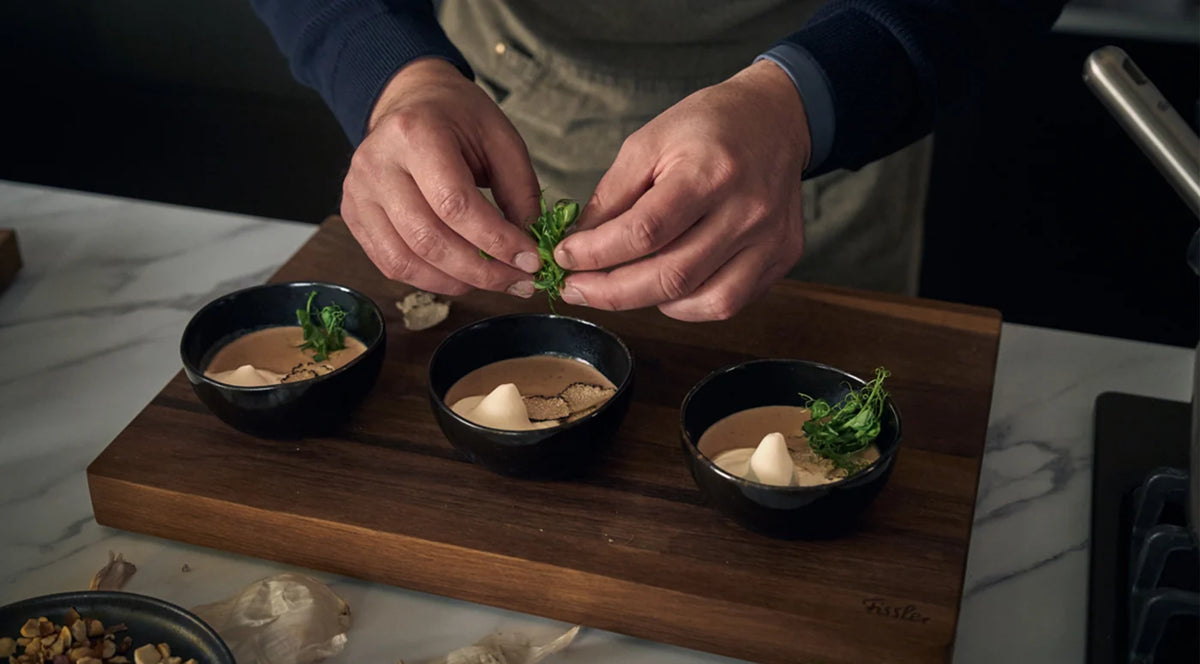
A person adds fresh herbs to three elegant black bowls of soup arranged on a wooden board, each bowl featuring a delicate white sphere and a slice of truffle, accompanied by garlic cloves and nuts. Crafted with Fissler’s precision-engineered cookware, the scene reflects timeless German design and innovation at the heart of every meal.

Chestnut velouté with black truffle, brown butter emulsion and pea shoots from the Vitavit® Premium

This chestnut velouté combines autumnal warmth with refined elegance. The sweetness of chestnuts meets the intense aroma of black truffle, while a brown butter emulsion adds depth and a pleasantly nutty note. Fresh pea shoots bring a light touch and a delightful contrast – a sophisticated starter for moments worth savoring.

To the recipe

Cooking Tips

More inspiration & tips from the professional kitchen

Master your stovetop and discover the versatility of uncoated stainless steel. We share our best kitchen secrets, product expertise, and inspiration to help you hone your cooking skills.